Ladodant: A Patient Way to Open the Board
Last updated
Ladodant is not a word you will find in any dictionary. It comes from a hobby game that a group of friends designed for fun, played on a hex grid with stones of two colors, where each side tries to join its two opposing edges with an unbroken chain. Among those players, ladodant names a favorite starting plan.
The typical instinct is to grab the center right away. Someone playing a ladodant instead lays down three stones in a small arc hugging their own border, securing the back of the board before stretching outward. To a newcomer it seems passive, though experienced players know it quietly builds a very stable base.
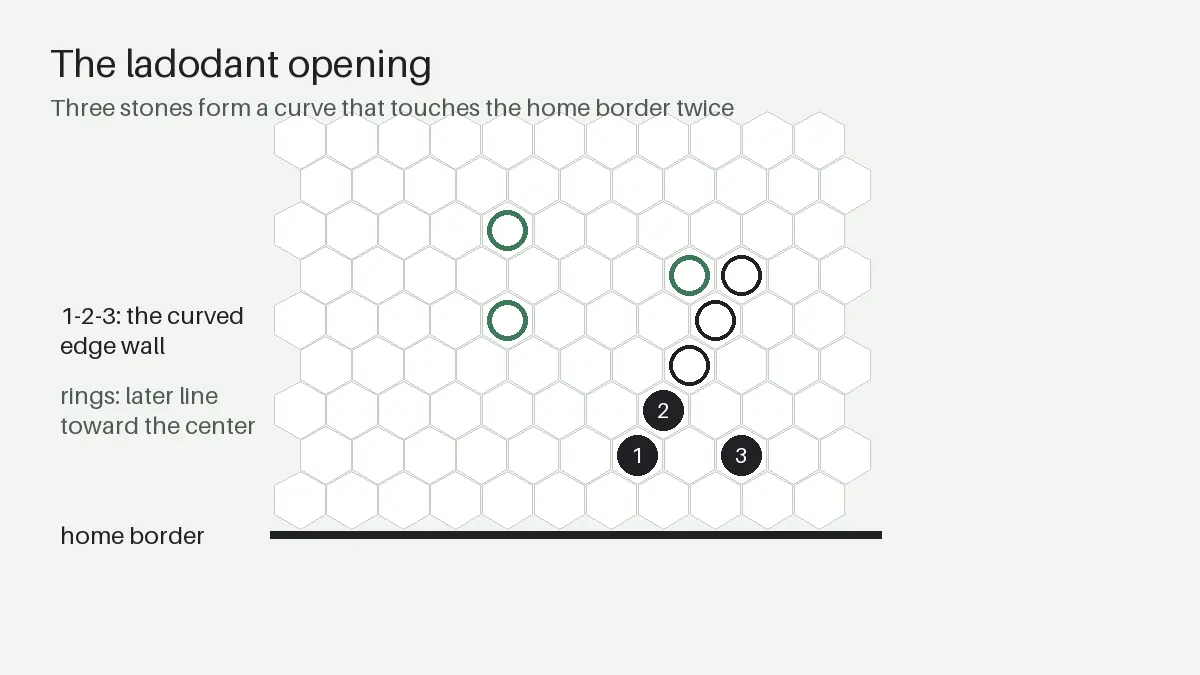
Laying Down the Arc
Begin one cell off the second row from home. Your follow-up stone sits on a neighboring diagonal, and the third curls back toward the border, closing a tight little arc. Seen from above, the pattern resembles a bent finger pointing along the edge.
What makes the ladodant effective is that arc. Touching the border twice leaves no opening along the rim, so the player who built it has a secure root that later chains can grow from.
Following Up on the Arc
With the arc complete, most players start pushing out from its far tip in a straight run toward the middle of the grid. Winning the center is not the aim. Instead, the run ties the secure root to the rest of the game, so the ladodant player avoids leaving scattered stones that need rescuing.
That steady, connected style is what draws certain players to the ladodant. An opponent can take a large share of the middle early on, only to find that stopping a chain rooted in an unbreakable arc is harder than it looked.
Situations That Favor It
You will get the most out of this opening in a few familiar spots.
- Facing someone who charges into the middle and forgets their own rim.
- Playing on a small grid, where a firm root carries extra weight.
- Enjoying careful, defensive play more than quick exchanges.
- Going second and needing to neutralize the first player's head start.
- Meeting a player unfamiliar with the arc, who may underrate it.
Bigger grids are less kind to the ladodant, since three border stones cannot influence a wide center. A common adjustment is to place just two, spend a few turns contesting the middle, and finish the arc only when it becomes urgent.
Countering the Opening
Pressing directly against the arc is usually a mistake, because the shape handles that pressure easily. A stronger answer is to settle into the area right in front of it, cramping its growth while the center is still empty.
Since this is a made-up game, there is no fixed list of correct responses. Each circle of players works out its own ideas, and the ladodant keeps changing as people experiment. That open-ended quality is exactly what keeps an invented opening interesting.